
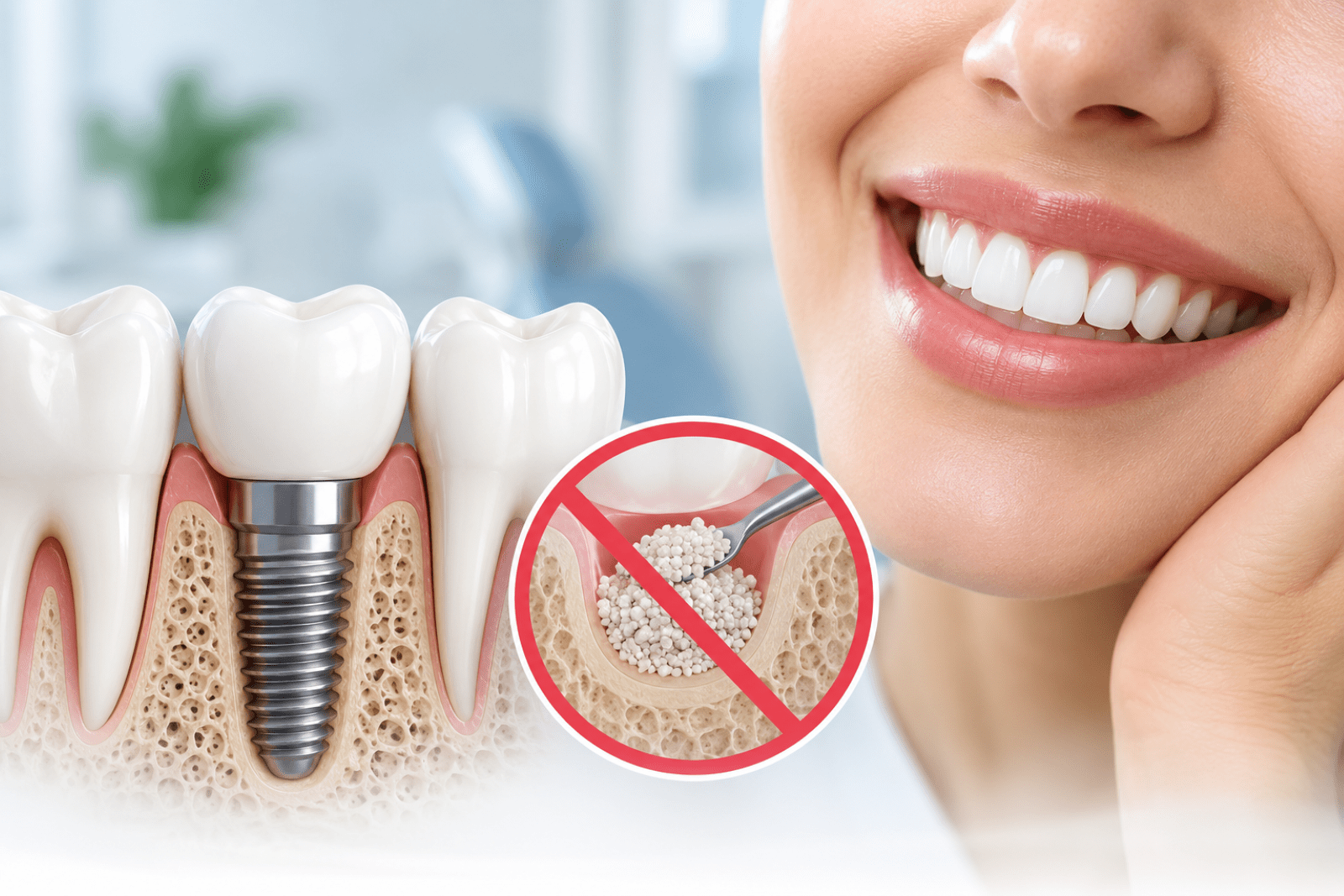
Losing a tooth can affect much more than the appearance of a smile. A missing tooth may make chewing more difficult and can contribute to changes in the surrounding teeth and jawbone. Dental implants offer a long-term tooth replacement option by using a small implant placed in the jawbone to support a crown, bridge, or denture.
One common concern is whether sufficient jawbone is available to support an implant. Bone naturally changes after tooth loss, and some patients may be told that they need a bone graft before implant placement. However, dental implants without a bone graft can be possible in selected cases.
The need for grafting depends on several factors, including the amount and density of existing bone, the location of the missing tooth, the proposed implant position, gum health, and overall oral health. At Akash Dental Care, we assess these factors carefully before recommending an implant treatment approach for each patient.
Can You Get Dental Implants Without a Bone Graft?
Yes, some patients can receive dental implants without bone grafting when there is already enough healthy jawbone to provide adequate support and stability for the implant.
An implant needs sufficient bone around its planned position. The bone must provide enough width, height, and density for the implant to be placed securely while maintaining healthy surrounding tissues. If these conditions are present, a separate bone-grafting procedure may not be necessary.
Importantly, having some degree of bone loss does not automatically mean that grafting will be required. The remaining bone may still be adequate for an appropriately planned implant. In other situations, the implant position or design may be adjusted to work with the patient’s existing anatomy.
A thorough dental examination and appropriate imaging are essential before making this decision. Clinical examination, dental X-rays, and, where indicated, 3D CBCT imaging can help the dental implant dentist evaluate the available bone and determine whether an implant can be placed safely.
When Are Dental Implants Possible Without Bone Grafting?
The possibility of implants without bone grafting depends on individual anatomy rather than simply whether a patient has experienced tooth loss.
1. Adequate Existing Jawbone
Patients with sufficient bone volume at the implant site may not require grafting. Adequate bone width and height allow the implant to be positioned within the available supporting structure.
Bone quality is also important. The dentist evaluates whether the existing bone can provide sufficient primary stability when the implant is placed. A healthy implant site with appropriate bone support may allow treatment to proceed without a separate augmentation procedure.
2. Recent Tooth Loss
The timing of implant treatment following tooth extraction can influence the amount of bone available. After a tooth is removed, the bone that previously surrounded its root can gradually remodel and decrease in volume.
When an implant is planned relatively soon after extraction, there may be more favorable bone anatomy available, although this is not guaranteed. In selected cases, an implant may even be considered immediately after extraction when the clinical conditions are appropriate.
3. Limited Bone Loss
Some patients have experienced bone resorption but still retain enough bone for conventional implant placement. The extent and location of bone loss are more important than simply identifying the presence of bone loss.
For example, a small reduction in bone volume may not prevent implant placement, while more extensive horizontal or vertical loss may require augmentation.
4. Alternative Implant Placement Techniques
Certain implant-planning approaches may allow treatment in patients whose anatomy would otherwise make conventional placement more challenging. These may include carefully selected implant positions, short implants, or angled placement.
These approaches are not universal substitutes for bone grafting. Their suitability depends on factors such as the location of the missing tooth, available bone, bite forces, surrounding anatomy, and the type of final restoration planned.
Interesting Read: Dental Implant Surgery: What to Expect During the Procedure
When is Bone Grafting Needed for Dental Implants?
Bone can gradually shrink following tooth loss because the jawbone no longer receives the same stimulation from a natural tooth root. The amount of change varies from person to person and can be influenced by the location of the missing tooth, periodontal disease, infection, trauma, and the length of time the tooth has been missing.
Bone grafting for dental implants may be recommended when the existing bone does not provide an adequate foundation for predictable implant placement.
A graft may be considered when there is insufficient:
- Bone width to surround the implant
- Bone height for the planned implant length
- Bone volume in the intended implant position
- Bone quality or density for adequate stability
- Supporting structure around the planned restoration
The need for grafting also varies according to the area of the mouth. The bone requirements for an implant in the front of the upper jaw can differ from those associated with a molar in the lower jaw. The relationship between the proposed implant and structures such as the sinus or nerves can also affect treatment planning.
Rather than assuming that grafting is necessary, the dentist evaluates the actual anatomy and determines whether sufficient bone is available for the planned implant.
How Does a Dentist Determine If You Need a Bone Graft?
Determining whether you can receive a dental implant without bone grafting involves more than looking at the missing tooth.
The process may include the following:
1. Dental Examination
The dentist examines the missing-tooth area, surrounding teeth, gums, bite, and oral tissues. Existing restorations and signs of infection or inflammation may also be assessed.
2. Medical and Dental History
Medical conditions, medications, previous dental procedures, smoking or tobacco use, and previous tooth loss can all be relevant to implant planning. A complete history helps the dentist identify factors that could affect healing and treatment.
3. Gum Health Assessment
Healthy gums and adequate periodontal support are important for implant treatment. Active gum disease may need to be addressed before implant placement.
4. X-Rays
Digital Dental X-rays provide information about the teeth, roots, jawbone, and surrounding structures. They can help establish an initial understanding of the implant site.
5. 3D CBCT Imaging
When more detailed information is needed, a CBCT scan can provide three-dimensional information about the jaw. This can help evaluate bone dimensions and the relationship between the proposed implant and nearby anatomical structures.
6. Bone Height and Width Assessment
The dentist evaluates whether there is enough bone in the specific location where the implant is intended to be placed. Measurements can help determine whether conventional placement is possible or whether augmentation should be considered.
7. Planned Implant Position
The implant is not simply placed wherever bone happens to be available. Its position must also work with the planned crown or other restoration. The final restoration, bite, aesthetics, and surrounding anatomy are considered together when developing the treatment plan.
What Are the Options for Dental Implants Without Bone Grafting?
Depending on the patient’s anatomy, several approaches may be considered.
Conventional dental implants may be appropriate when adequate bone is already present. The implant can be positioned in the available bone and later restored after the appropriate healing period.
Short implants may be considered in selected situations where bone height is limited. Their use depends on the location, available bone, restoration requirements, and the dentist’s clinical assessment.
Angled implant placement can sometimes help make use of available bone while avoiding certain anatomical structures. This requires careful planning and is not suitable for every patient.
Other implant-planning techniques may also be considered depending on the individual case. The goal is not simply to avoid a bone graft, but to select an approach that provides appropriate support for the planned restoration and promotes predictable treatment.
What Happens If You Don’t Have Enough Bone for an Implant?
Placing an implant in an area with inadequate supporting bone can create problems with stability and the long-term support of the restoration. An implant requires sufficient surrounding bone to function properly under normal chewing forces.
If there is not enough bone, the dentist may recommend bone augmentation before or as part of implant treatment. Depending on the clinical situation, this may involve allowing the grafted area to heal before implant placement.
Proceeding with an unsuitable implant position simply to avoid grafting may compromise the overall treatment plan. Careful planning helps balance the available anatomy with the position required for the final tooth.
For this reason, the objective should be a suitable and stable implant treatment rather than avoiding a particular procedure at all costs.
Dental Implant Treatments: What Can You Expect?
Every treatment plan is individualized, but a typical sequence may include several stages.
Step 1: Initial consultation
The dentist discusses the missing tooth, oral health, treatment goals, and available tooth replacement options.
Step 2: Dental and bone assessment
The gums, teeth, bite, and implant site are evaluated to determine whether the mouth is ready for implant treatment.
Step 3: Imaging and treatment planning
X-rays or 3D imaging may be used to evaluate bone dimensions and plan the implant position.
Step 4: Bone grafting, if required
If insufficient bone is present, bone augmentation may be recommended before implant placement.
Step 5: Implant placement
The dental implant is surgically positioned in the jawbone according to the treatment plan.
Step 6: Healing and integration
The implant is given time to integrate with the surrounding bone. The required healing period varies between patients and treatment situations.
Step 7: Final restoration
Once the implant site is ready, a dental crown, bridge, or another restoration can be attached to restore function and appearance.
Step 8: Follow-up and maintenance
Regular dental visits and good oral hygiene help protect the implant and surrounding tissues over the long term.
Benefits of Dental Implants When Bone Grafting Isn’t Required
For patients who have adequate bone and do not need grafting, implant treatment may involve fewer stages. Avoiding a separate grafting procedure can simplify the treatment process and may reduce the overall treatment timeline.
Potential advantages can include:
- Fewer surgical treatment stages
- No separate bone-grafting procedure
- Potentially shorter overall treatment time
- Direct implant placement when clinically appropriate
- Restoration of chewing function
- Replacement of a missing tooth without relying on adjacent teeth for support
- Restoration of the appearance of the smile
These benefits depend on the individual’s circumstances. Avoiding grafting should never be the sole objective when planning treatment. The implant must still be placed in a position that provides appropriate support and works with the final restoration.
Interesting Read: How Long After Tooth Extraction Can You Get a Dental Implant?
Why Choose Akash Dental Care for Dental Implants in Gota?
Successful implant treatment begins with careful diagnosis and planning. At Akash Dental Care, we focus on understanding each patient’s oral health, available bone, and treatment requirements before recommending an approach.
Patients considering dental implants in Gota can receive an assessment designed around their specific needs. The treatment planning process may include clinical examination and appropriate diagnostic imaging to evaluate the implant site.
Our approach considers the condition of the gums, available bone, implant position, bite, and final restoration rather than relying on a standard treatment plan for every patient.
For patients seeking an implant dentist in Gota, treatment can be planned around whether conventional implants, a grafting procedure, or another clinically appropriate approach is indicated.
Akash Dental Care provides comprehensive implant dentistry, with attention to diagnosis, treatment planning, implant placement, restoration, and follow-up care. Patients can discuss their individual circumstances and available treatment options with the dental team.
For those looking for a dental clinic in Gota, Ahmedabad, an individualized examination is the best way to understand whether implants can be placed without bone grafting and what treatment sequence may be appropriate.
Dental Implants vs. Other Tooth Replacement Options
Dental implants are one of several ways to replace missing teeth. The appropriate choice depends on oral health, bone condition, the number of missing teeth, treatment requirements, budget, preferences, and clinical suitability.
| Tooth Replacement Option | General Purpose |
| Dental Implants | Replace missing teeth using an implant-supported restoration placed in the jawbone. |
| Dental Bridges | Replace missing teeth using support from adjacent teeth. |
| Dentures | Replace several missing teeth or complete sets of teeth using a removable appliance. |
A dental implant may provide an independent foundation for a replacement tooth, whereas a traditional bridge generally relies on neighboring teeth. Dentures offer another approach for replacing multiple or complete sets of missing teeth.
A consultation with a dentist can help determine which option is compatible with the condition of the mouth and the patient’s treatment goals.
Conclusion
Dental implants without bone graft can be possible when the existing jawbone provides sufficient height, width, density, and stability for the planned implant. However, the presence or absence of bone grafting cannot be determined from tooth loss alone.
A detailed dental examination and appropriate imaging help determine the condition of the implant site and whether conventional implant placement is suitable. When bone is insufficient, bone grafting for dental implants may provide the additional foundation needed for treatment. In selected cases, alternative implant-planning approaches may also be considered.
The most appropriate treatment depends on individual anatomy, oral health, implant position, and restoration requirements. For patients considering dental implants in Gota, Akash Dental Care can provide an individualized assessment and discuss the available treatment options.
Schedule a consultation with Akash Dental Care to find out whether you may be a candidate for dental implants in Gota without a bone graft and what approach may be suitable for your smile and oral health.
FAQs About Dental Implants Without Bone Grafting
Can you get dental implants without a bone graft?
Yes. Some patients have enough healthy bone to support an implant without a separate grafting procedure. The decision depends on bone height, width, density, implant position, gum health, and other clinical factors.
Can I get an implant if I have bone loss?
Possibly. Having bone loss does not automatically rule out implant treatment. If enough bone remains in a suitable position, an implant may still be possible. If bone is insufficient, augmentation may be recommended.
How do I know if I need bone grafting for dental implants?
A dentist can assess the implant site using a clinical examination and dental imaging. When necessary, 3D CBCT imaging can provide detailed information about bone height, width, and nearby anatomical structures.
Is bone grafting always required before dental implants?
No. Bone grafting is not required for every implant patient. It is generally considered when the existing bone does not provide an adequate foundation for the planned implant.
Are implants without bone grafts safe?
When an implant is appropriately planned and placed in sufficient healthy bone, treatment can be performed without a separate graft. A dentist must first determine whether the available anatomy can provide adequate support.
Can a dentist place an implant immediately after tooth extraction?
In selected cases, an implant may be placed immediately after extraction. Immediate placement depends on factors such as the condition of the extraction site, available bone, infection, gum tissues, and the planned restoration.
How long does dental implant treatment take without bone grafting?
Treatment time varies according to the patient’s oral health, implant location, healing response, and restoration requirements. Without a separate grafting stage, the overall process may involve fewer stages, but healing and implant integration are still necessary.
What happens if there isn’t enough bone for an implant?
If the available bone cannot adequately support the planned implant, the dentist may recommend bone augmentation or consider another implant approach. The treatment plan should account for the anatomy and requirements of the final restoration.
Are short implants an alternative to bone grafting?
Short implants can be considered in selected patients with limited bone height. They are not appropriate for every situation, so the dentist must assess the location, bone quality, bite forces, and restoration requirements before recommending them.
How much do dental implants cost in Gota?
The cost of dental implants in Gota varies according to the number of teeth being replaced, implant system, restoration, diagnostic requirements, and whether procedures such as bone grafting are necessary. An examination is needed for an individualized estimate.
How do I choose an implant dentist in Gota?
Consider the dentist’s experience with implant treatment, diagnostic and planning process, range of treatment options, approach to oral health, and ability to provide appropriate follow-up care. A consultation can help you understand the proposed treatment plan.
Where can I get dental implants in Gota?
Akash Dental Care provides implant dentistry for patients considering tooth replacement in Gota. An individual assessment can determine whether conventional implants, treatment without grafting, or another approach is appropriate.