
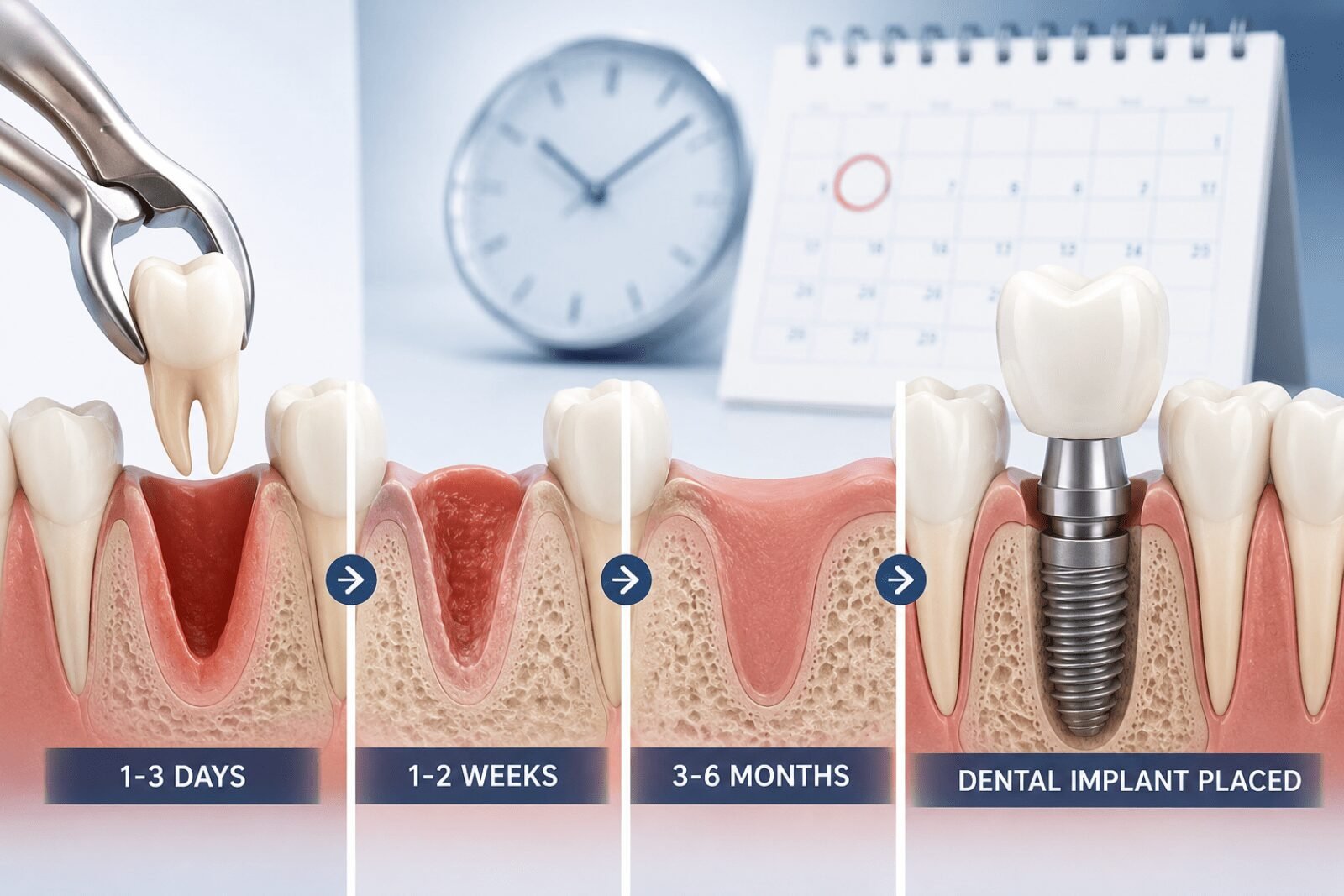
Losing a tooth can be stressful, especially when you are unsure about what happens after extraction. Many patients who need a tooth removed immediately start wondering, “When can I replace the missing tooth with a dental implant?” The answer is not the same for everyone. Some patients may be suitable for an implant shortly after extraction, while others need to wait several months for the gum and jawbone to heal.
The timing of a dental implant depends on several factors, including the reason for extraction, the condition of the jawbone, the presence of infection, gum health, and your overall healing ability. Your dentist will examine the extraction site and use dental X-rays or 3D imaging when necessary before recommending the right treatment timeline.
If you are looking for Tooth Extraction Treatment in Gota, understanding what happens after extraction can help you make a more informed decision about replacing the missing tooth.
Why is a Dental Implant Needed After Tooth Extraction?
A natural tooth does more than help you chew food. Its root also stimulates the surrounding jawbone and helps maintain the shape and strength of the bone. When a tooth is removed, that stimulation disappears. Over time, the bone in that area can gradually shrink.
A dental implant is designed to replace the missing tooth from the root upward. It consists of a small implant post placed into the jawbone, followed by an abutment and dental crown. Once the implant has successfully integrated with the bone, it can provide a stable and natural-looking replacement.
Replacing a missing tooth can help:
- Restore chewing ability
- Improve speech and pronunciation
- Maintain the alignment of neighbouring teeth
- Reduce unwanted movement of surrounding teeth
- Support the structure of the jaw
- Restore the appearance of your smile
- Provide a long-term tooth replacement option
However, an implant should not simply be placed according to a fixed number of days after extraction. The condition of your mouth is more important than the calendar.
How Soon Can You Get a Dental Implant After Extraction?
The timeline for getting a dental implant after tooth extraction depends on several factors, including your bone health, gum condition, and whether any infection or bone loss is present. In general, dentists consider three common timing options for implant placement.
1. Same-Day or Immediate Implant Placement
In carefully selected cases, a dental implant may be placed during the same appointment as the tooth extraction. This is called immediate implant placement.
This approach may be considered when:
- The tooth has been removed without significant damage to the surrounding bone.
- There is a sufficient healthy jawbone.
- The gums are in good condition.
- There is no uncontrolled infection.
- The patient has suitable overall oral health.
- The implant can be positioned securely in the available bone.
Immediate placement can reduce the number of surgical appointments and may help preserve the available bone structure. However, it is not suitable for every patient.
Your dentist must carefully evaluate the extraction site before deciding whether immediate implant placement is appropriate.
2. Implant Placement After a Few Weeks
Sometimes the dentist may recommend allowing the soft tissues to heal before placing the implant. This may take several weeks.
This approach can be useful when the gum needs time to recover after extraction but the dentist does not need to wait for complete bone healing.
The exact waiting period depends on the condition of the extraction site and the individual’s healing process.
3. Implant Placement After Several Months
In some cases, the dentist may recommend waiting for the extraction site and jawbone to heal more completely before placing the implant. This can take several months.
A longer healing period may be recommended when:
- There was a significant infection around the tooth.
- Bone loss is present.
- The extraction was complicated.
- Bone grafting is required.
- The gum needs additional time to heal.
- The implant needs stronger bone support.
Although waiting may feel frustrating, it can improve the conditions needed for successful implant placement.
Interesting Read: When is Tooth Extraction Treatment Necessary? Key Signs You Shouldn’t Ignore
What If There is an Infection After Tooth Extraction?
One of the most important factors affecting implant timing is infection.
If the tooth was removed because of a severe infection, abscess, or advanced dental decay, your dentist may want the infection to resolve before placing an implant. Placing an implant into an unhealthy or infected area may affect healing and implant stability.
This does not necessarily mean that you cannot have a dental implant. It simply means that your dentist may need to treat the infection first and allow the tissues to recover.
In some situations, bone grafting may also be recommended to rebuild lost bone before implant placement.
Do You Always Need a Bone Graft After Extraction?
No. Not every patient needs a bone graft.
However, if the jawbone has become too thin or has been damaged by infection or previous tooth loss, there may not be enough bone to support an implant properly.
A bone graft involves adding bone-graft material to the area where additional bone is needed. The area is then allowed to heal before implant placement.
The healing time varies depending on the amount and type of grafting required. Your dentist will explain whether grafting is necessary after examining your X-rays and the condition of your jawbone.
This is one reason why it is better not to delay a dental consultation after losing a tooth. Early evaluation allows your dentist to plan tooth replacement before significant bone changes occur.
What Happens During the Dental Implant Process?
Many patients feel more comfortable when they understand what happens during the dental implant procedure. The treatment is completed in several stages, and your dentist will guide you through each step.
Step 1: Dental Examination
Your dentist first examines your teeth, gums, bite, and extraction site. Dental X-rays or 3D scans may be used to assess bone height, width, and the position of important structures.
Step 2: Treatment Planning
Once your dentist understands your oral condition, they can determine whether an implant can be placed immediately or whether healing, bone grafting, or another procedure is required first.
Step 3: Implant Placement
The implant post is carefully placed into the jawbone. Local an aesthesia is generally used to keep the procedure comfortable.
Step 4: Healing and Osseointegration
After placement, the implant needs time to bond with the surrounding bone. This biological process is known as osseointegration.
The length of healing varies between patients. During this period, your dentist will monitor the implant and surrounding tissues.
Step 5: Abutment and Crown
Once the implant has healed sufficiently and is stable, an abutment and custom-made dental crown can be placed. The crown is designed to match your surrounding teeth as closely as possible.
Can You Get an Implant Immediately After Every Extraction?
No. Immediate implants are not appropriate for every extraction.
For example, if there is extensive infection, severe bone loss, insufficient bone support, or other complications, your dentist may recommend delaying implant placement.
Trying to rush the process simply because you want your missing tooth replaced quickly is not always the best approach. The priority should be creating healthy and stable conditions for the implant.
A good treatment plan considers both the short-term procedure and the long-term health of your smile.
What Should You Do After Tooth Extraction?
Your actions after extraction can also influence healing.
Your dentist may recommend that you:
- Keep the extraction area clean according to their instructions.
- Avoid disturbing the blood clot.
- Follow prescribed medication instructions.
- Avoid smoking or tobacco products during healing.
- Eat softer foods initially if recommended.
- Avoid strenuous activity for the period advised by your dentist.
- Attend follow-up appointments.
- Contact your dentist if you experience unusual swelling, persistent bleeding, severe pain, or other concerning symptoms.
Do not place pressure on the extraction area unnecessarily. Good aftercare gives the tissues the best opportunity to heal properly.
How Long Does the Complete Implant Process Take?
The complete process can take several months, although the timeline differs from person to person.
For some patients, an implant can be placed immediately after extraction. For others, the dentist may recommend several weeks or months of healing before implant placement.
If bone grafting is needed, the overall treatment period may become longer.
It is important to understand that the dental implant treatment process is not simply about placing a replacement tooth. Your dentist needs to ensure that the jawbone, gums, implant, and final crown work together properly.
Patience during the healing stages can contribute to a stronger and more predictable result.
What If You Wait Too Long to Replace a Missing Tooth?
Some patients decide to postpone implant treatment because the missing tooth does not cause immediate pain. However, a missing tooth can gradually affect the surrounding oral structures.
The neighbouring teeth may begin shifting into space. Changes in the bite can occur, and bone loss may continue in the area where the tooth root was previously present.
This does not mean every missing tooth requires an immediate implant. Your dentist can discuss alternative options based on your age, oral health, bone condition, budget, and long-term goals.
The important point is to have the area evaluated rather than simply ignoring the missing tooth.
When Should You See a Dentist After Tooth Extraction?
It is a good idea to discuss tooth replacement during your extraction consultation rather than waiting until several months later.
If your dentist knows that you may want an implant, they can plan the extraction carefully and consider ways to preserve the bone. In suitable cases, procedures such as socket preservation may help maintain the extraction area for future implant treatment.
If you are searching for a tooth extraction dentist in Gota, choose a dental professional who can discuss both the extraction and your future tooth-replacement options.
Patients from Adani Shantigram, Jagatpur, Tragad, New Ranip, Sola, Science City, Chandkheda, Vaishnodevi Circle, and Godrej Garden City can also consider a dental consultation in the Gota area for personalized treatment planning.
Can You Have Other Dental Treatments During This Time?
Yes. Your dental treatment plan does not necessarily stop after an extraction.
Depending on your oral health, your dentist may recommend other treatments such as professional teeth cleaning, gum treatment, restorative dentistry, or orthodontic care.
For patients who need orthodontic treatment, discussing your missing tooth and extraction history with your dentist and orthodontist is important before starting treatment. If you are considering the best braces treatment in Ahmedabad, your dentist can help determine how your overall dental condition may affect your orthodontic plan.
How Can You Know the Right Implant Timeline for You?
There is no universal waiting period that works for every patient.
The right time depends on:
- The reason the tooth was extracted
- The amount of bone available
- Gum health
- Presence or absence of infection
- Healing after extraction
- Whether bone grafting is needed
- Your overall health and healing capacity
- The location of the missing tooth
- The stability that can be achieved during implant placement
A dental examination and appropriate imaging are the best ways to determine your individual timeline.
If you are searching for a tooth extraction dentist in Ahmedabad, don’t hesitate to ask about tooth replacement before or immediately after your extraction. Early planning can make the overall treatment process more organised.
Conclusion
There is no single answer to the question, “How long after tooth extraction can you get a dental implant?” Some patients may be candidates for an immediate implant, while others benefit from waiting several weeks or months. The decision depends on the condition of the extraction site, bone quality, gum health, infection, and individual healing.
The best approach is to plan tooth replacement with your dentist from the beginning. A proper examination allows your dentist to determine whether immediate placement, delayed placement, bone preservation, or bone grafting is the most suitable option.
If you have recently had a tooth removed or have been advised to undergo an extraction, don’t wait until the area has completely healed before asking about replacement options. Early planning can help protect your oral health and make future treatment more predictable.
For personalized advice, consult a qualified dental professional who can assess your individual needs and explain the available options. If you are looking for the best dentist in Gota, a consultation can help you understand your extraction, healing, and tooth-replacement choices before deciding on the next step.
Frequently Asked Questions
1. How long after tooth extraction can I get a dental implant?
The timing varies. Some suitable patients can receive an implant immediately, while others may need several weeks or months for healing. Your dentist decides after checking the bone, gums, and extraction site.
2. Can a dental implant be placed on the same day as extraction?
Yes, immediate implant placement is possible in selected cases. It generally requires adequate bone, healthy surrounding tissues, and suitable conditions for implant stability. Not every extraction is suitable for this approach.
3. What happens if I have an infection?
Your dentist may treat the infection and allow the area to heal before implant placement. The required waiting period depends on the severity of infection and the condition of the surrounding bone.
4. Will I need a bone graft before an implant?
Not necessarily. Bone grafting is recommended when there is insufficient bone to support the implant. Your dentist can determine this using clinical examination and dental imaging.
5. Is it necessary to replace a missing tooth?
Replacement is not always urgent, but leaving a missing tooth untreated can allow neighbouring teeth to shift and may contribute to bone loss. Discussing your options early helps you make an informed decision.
6. How long does a dental implant take to heal?
Healing varies between patients. The implant needs time to integrate with the jawbone before the final crown is attached. Your dentist will monitor healing and determine when the implant is ready for restoration.
7. Can I eat normally after tooth extraction?
Immediately after extraction, your dentist may recommend softer foods and avoiding the extraction site. As healing progresses, you can generally return to your normal diet according to your dentist’s advice.