
Missing teeth can affect more than just your smile. They may make chewing difficult, affect speech, and cause nearby teeth to shift over time. Fortunately, dental bridges offer a reliable way to replace missing teeth and restore your smile’s appearance and function.
There are different types of dental bridges, and each is designed to address specific tooth replacement needs. Some use natural teeth for support, while others rely on dental implants or bonding techniques. Understanding these options can help you make a more informed decision about your dental treatment.
At Akash Dental Care, patients in Gota, Ahmedabad, looking for dental bridge treatment can explore suitable tooth replacement options based on their oral health, missing teeth, and treatment needs. This guide explains the four common dental bridge types, their benefits, uses, and differences to help you understand which option may be appropriate.
What Are Dental Bridges and How Do They Work?
A dental bridge is a fixed dental restoration used to replace one or more missing teeth. It consists of artificial teeth, known as pontics, that fill the empty space in your smile. Depending on the bridge design, these artificial teeth are supported by natural teeth, dental crowns, or dental implants.
Dental bridges help restore the appearance of your smile while improving chewing function and supporting proper tooth alignment. They can also help prevent nearby teeth from gradually moving into the space left by a missing tooth.
The way a dental bridge works depends on its design. For example, a traditional bridge uses crowns placed over supporting natural teeth, whereas an implant-supported bridge is secured to dental implants positioned in the jawbone.
Choosing the right dental bridge requires an evaluation of your gums, supporting teeth, bite alignment, and overall oral health.
Different Types of Dental Bridges
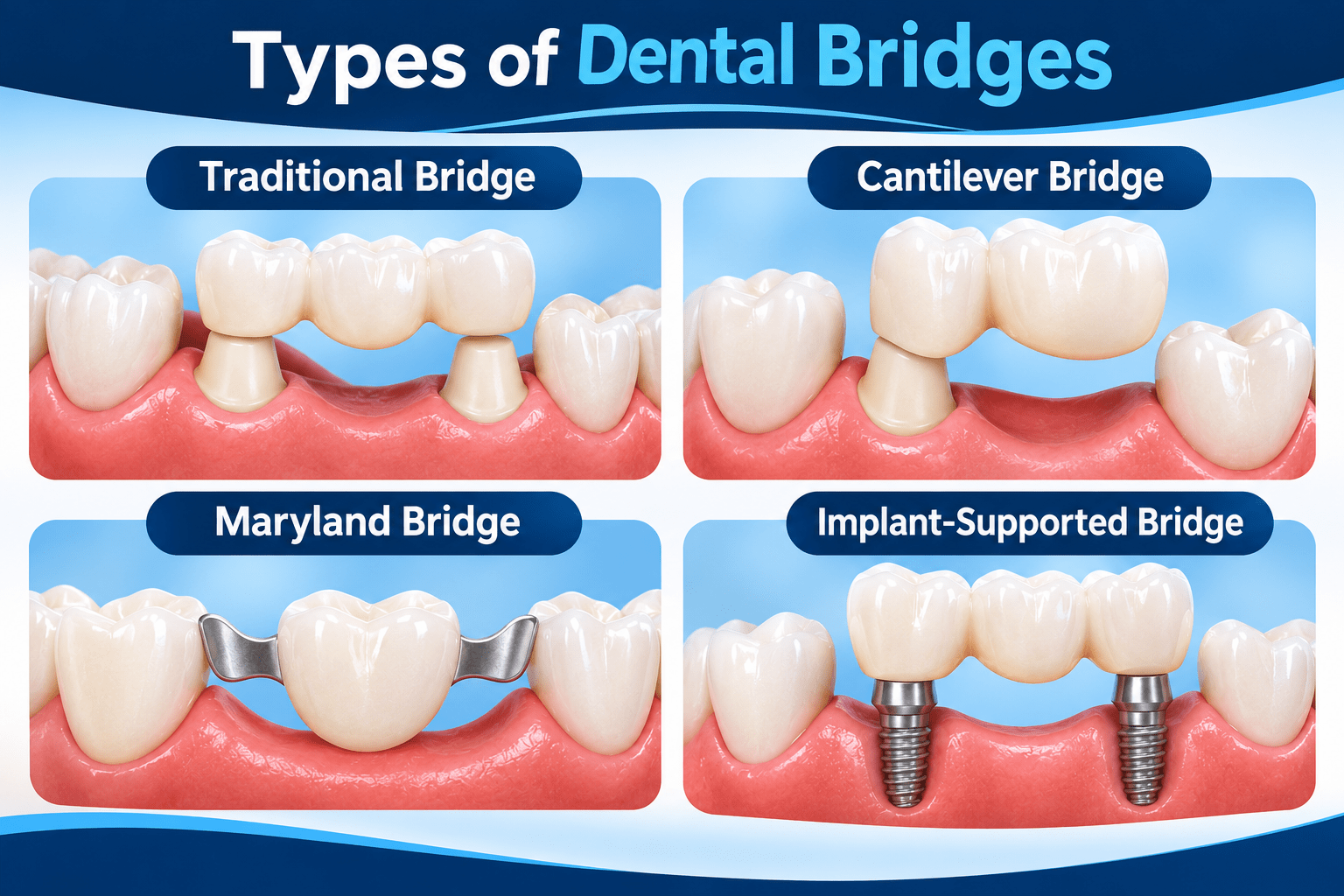
There are four commonly used dental bridge types: traditional, cantilever, Maryland, and implant-supported. Each has a different support structure, treatment approach, and suitability depending on the location and number of missing teeth.
Let’s understand how each option works.
1. Traditional Dental Bridge
A traditional dental bridge is one of the commonly used options for replacing missing teeth. It consists of an artificial tooth held in place by dental crowns fitted over the natural teeth on both sides of the gap.
These supporting teeth are called abutment teeth. The crowns provide stability and hold the artificial tooth securely in position.
How Does a Traditional Dental Bridge Work?
The dentist prepares the supporting teeth by removing a small amount of enamel to make space for the crowns. Impressions or digital scans are then taken to create a customized bridge that fits your teeth properly.
Once the restoration is ready, the dentist checks its fit and bite before securing it in place.
Benefits of a Traditional Dental Bridge:
- Provides stable support for replacing missing teeth.
- Restores chewing ability and smile appearance.
- Can replace one or more consecutive missing teeth.
- Offers a fixed tooth replacement option.
- Helps maintain the alignment of surrounding teeth.
When is a Traditional Dental Bridge Suitable?
A traditional dental bridge may be recommended when you have healthy and sufficiently strong natural teeth on both sides of the missing tooth gap. It can be a suitable option when the adjacent teeth already need crowns or have significant existing restorations.
However, preparing healthy supporting teeth is an important consideration before choosing this treatment.
2. Cantilever Dental Bridge
A cantilever dental bridge is a type of fixed dental restoration supported by a natural tooth on only one side of the missing tooth gap.
Unlike a traditional bridge, which generally uses supporting teeth on both sides, a cantilever bridge relies on a single adjacent tooth for support.
How Does a Cantilever Dental Bridge Work?
The supporting tooth is prepared to receive a dental crown, which holds the artificial replacement tooth in place. The bridge extends from the supporting tooth into the empty space.
This design allows dentists to replace a missing tooth when suitable support is available on only one side.
Benefits of a Cantilever Dental Bridge:
- Requires only one adjacent supporting tooth.
- Provides a fixed replacement for selected missing teeth.
- Can be considered when a supporting tooth is available on one side.
- Restores the appearance of the smile.
- May be useful in specific situations where other bridge designs are unsuitable.
When is a Cantilever Dental Bridge Suitable?
A cantilever dental bridge may be considered when there is only one suitable supporting tooth next to the missing tooth space. However, it is not appropriate for every patient.
Since the supporting tooth receives additional pressure during chewing, dentists carefully evaluate bite alignment, tooth strength, and the location of the missing tooth before recommending this option.
3. Maryland Dental Bridge
A Maryland dental bridge, also called a resin-bonded bridge, is a conservative tooth replacement option commonly considered for missing front teeth.
Unlike traditional dental bridges, it does not usually require full crowns on the adjacent natural teeth. Instead, it uses small metal or ceramic wings attached to the back surfaces of neighboring teeth.
These wings help hold the artificial tooth in place while preserving more of the natural tooth structure.
How Does a Maryland Dental Bridge Work?
The dentist prepares the back surfaces of the supporting teeth, if needed, and creates a customized artificial tooth with supporting wings. The wings are then bonded to the adjacent teeth using dental adhesive.
This approach provides a fixed replacement while generally requiring less removal of natural tooth structure than a traditional bridge.
Benefits of a Maryland Dental Bridge:
- Preserves more natural tooth structure.
- Usually requires minimal preparation of adjacent teeth.
- Provides an option for replacing missing front teeth.
- Offers a natural-looking appearance when properly designed.
- Avoids the need for full crowns on supporting teeth.
When is a Maryland Dental Bridge Suitable?
A Maryland dental bridge is often considered for patients who have a missing front tooth and healthy neighboring teeth.
However, its suitability depends on the condition of the supporting teeth, bite pressure, and available bonding surfaces. In some cases, a dental crown for tooth repair may be recommended to restore damaged or weakened teeth and provide additional protection. One limitation is that the bonded wings may become detached over time, requiring repair or rebonding.
4. Implant-Supported Dental Bridge
An implant-supported dental bridge is a tooth replacement option that uses dental implants instead of natural teeth for support.
Dental implants are small, biocompatible posts placed in the jawbone to act as artificial tooth roots. After the implants integrate with the surrounding bone, a customized dental bridge is attached to them.
This option is particularly useful for replacing multiple missing teeth in a row without depending on neighboring natural teeth for support.
How Does an Implant-Supported Dental Bridge Work?
The treatment begins with a dental examination to evaluate your jawbone, gums, and overall oral health. Based on the assessment, the dentist determines the appropriate implant positions and treatment plan.
The general process includes:
- Initial Examination: The dentist evaluates your missing teeth, gum condition, and jawbone health.
- Implant Placement: Dental implants are surgically positioned in the jawbone.
- Healing Period: The implants are allowed to integrate with the surrounding bone.
- Bridge Preparation: A customized bridge is created to fit the implant-supported structure.
- Final Placement: The bridge is attached to the implants, and its fit and bite are checked.
The treatment timeline varies depending on healing, bone condition, and whether additional procedures are required.
Benefits of an Implant-Supported Dental Bridge:
- Provides stable support for multiple replacement teeth.
- Does not require preparation of neighboring natural teeth.
- Helps maintain bone stimulation around implant sites.
- Restores chewing function and smile appearance.
- Offers a long-term tooth replacement option with proper care.
When is an Implant-Supported Dental Bridge Suitable?
This treatment may be suitable for patients who have multiple missing teeth and adequate jawbone support or are eligible for additional procedures to prepare the implant site.
Patients considering implant dentistry should undergo a detailed examination to determine whether their bone health, gum condition, and general dental needs support this treatment.
Dental Bridge Types: Understanding the Key Differences
Although all four dental bridge options help replace missing teeth, their support structures and treatment requirements are different. Understanding these differences can help you discuss suitable options with your dentist.
| Dental Bridge Type | Support System | Common Uses | Main Advantage |
| Traditional | Crowns on adjacent natural teeth | One or more consecutive missing teeth | Strong and stable support |
| Cantilever | One adjacent supporting tooth | Selected cases with suitable bite conditions | Requires support on one side |
| Maryland | Bonded wings on adjacent teeth | Commonly used for front teeth | Preserves more natural tooth structure |
| Implant-Supported | Dental implants | Multiple missing teeth | Does not rely on adjacent natural teeth |
The most appropriate option depends on the location of the missing teeth, the condition of surrounding teeth, bite alignment, and jawbone health.
Types of Dental Bridges and Their Uses
Different dental bridge options serve different purposes. Your dentist considers the number of missing teeth, their location, and the condition of your remaining teeth before recommending a restoration.
Here are some common situations where dental bridges may be considered:
1. Replacing a Single Missing Tooth
A traditional, Maryland, or implant-supported restoration may be considered depending on whether the missing tooth is in the front or back of the mouth and the condition of the neighboring teeth.
2. Replacing Multiple Consecutive Missing Teeth
Traditional bridges or implant-supported bridges may be suitable for replacing multiple teeth in a row. The number and placement of supporting teeth or implants depend on the treatment plan.
3. Replacing Missing Front Teeth
Maryland dental bridges are often considered for front teeth because they can preserve more of the neighboring natural tooth structure. Traditional and implant-supported options may also be appropriate in selected cases.
4. Replacing Teeth Without Preparing Neighboring Teeth
An implant-supported dental bridge can replace missing teeth without using adjacent natural teeth as supports. This can be beneficial when neighboring teeth are healthy and should be preserved.
5. Restoring Teeth With Limited Supporting Options
A cantilever dental bridge may be considered in specific situations where support is available on only one side. However, careful evaluation is necessary because of the additional pressure on the supporting tooth.
Interesting Read: How Soon Should You Replace a Missing Tooth With an Implant?
Which Type of Dental Bridge is Best?
There is no single best dental bridge for everyone. The right option depends on your oral health, the number of missing teeth, and the condition of your surrounding teeth.
Before recommending a treatment, dentists generally consider the following factors:
1. Number of Missing Teeth
A single missing tooth may require a different restoration than multiple consecutive missing teeth. The number of missing teeth helps determine the appropriate bridge design and support system.
2. Condition of Supporting Teeth
Traditional and cantilever bridges depend on natural teeth for support. If these teeth are weak or damaged, other treatment options may need to be considered.
3. Jawbone Health
Jawbone condition is particularly important when considering implant-supported dental bridges. Adequate bone support is required for successful implant placement, although bone grafting may be an option in some cases.
4. Bite Alignment
Your bite affects how much pressure is placed on a dental bridge. Dentists evaluate chewing forces and tooth alignment to determine which bridge design can provide appropriate support.
5. Oral Hygiene and Gum Health
Healthy gums and good oral hygiene are important for maintaining dental restorations. Existing gum problems may need treatment before a dental bridge is placed.
6. Treatment Time and Budget
Different dental bridge types involve different procedures, materials, and treatment timelines. Your dentist can explain the available options and associated costs based on your requirements.
A professional consultation at a dental clinic can help you understand the advantages and limitations of each option before making a decision.
Benefits of Choosing a Fixed Dental Bridge for Missing Teeth
A fixed dental bridge can help restore your smile and improve everyday oral functions. It is designed to remain in place rather than being removed regularly like a removable denture.
Some important benefits include:
- Improved Chewing Function: Replacing missing teeth can make it easier to bite and chew different types of food.
- Better Smile Appearance: Artificial teeth fill visible gaps and help restore a complete-looking smile.
- Support for Tooth Alignment: A dental bridge can help prevent neighboring teeth from drifting into the empty space.
- Improved Speech: Replacing certain missing teeth may help address speech difficulties caused by gaps.
- Fixed Tooth Replacement: Many dental bridge designs remain securely attached during everyday activities.
- Restored Confidence: A complete smile may help patients feel more comfortable when speaking and interacting with others.
The results and long-term performance depend on the bridge type, oral hygiene, supporting structures, and regular dental care.
What is the Dental Bridge Treatment Process?
Dental bridge treatment generally involves several steps to ensure the restoration fits comfortably and functions properly. The exact procedure depends on the type of bridge selected.
Step 1: Initial Dental Examination
The dentist examines your teeth, gums, bite, and missing tooth area. Dental X-rays or other imaging may be recommended to evaluate the supporting structures.
Step 2: Treatment Planning
After the examination, the dentist discusses suitable dental bridge options. The treatment plan considers your oral health, functional requirements, and expected results.
Step 3: Tooth Preparation or Implant Placement
For traditional and cantilever bridges, the supporting natural teeth are prepared to receive crowns. For Maryland bridges, the neighboring teeth are prepared for bonding when necessary. Implant-supported bridges require implant placement.
Step 4: Bridge Fabrication
Impressions or digital scans are used to create a customized restoration. The artificial teeth are designed to match the surrounding teeth in shape, size, and appearance.
Step 5: Dental Bridge Placement
The completed bridge is positioned and checked for proper fit, comfort, and bite alignment. Depending on the restoration, it is bonded, cemented, or attached to the dental implants.
Step 6: Follow-Up and Maintenance
Your dentist checks the restoration and provides instructions for cleaning and maintenance. Regular follow-up appointments help monitor the condition of the bridge and surrounding oral tissues.
How to Care for Your Dental Bridges
Proper maintenance plays an important role in keeping your dental bridge comfortable and functional. Although dental bridges replace missing teeth, the surrounding gums and supporting structures still require regular attention.
Follow these care tips:
- Brush Twice Daily: Use a soft-bristled toothbrush and fluoride toothpaste to clean your teeth and the bridge.
- Clean Under the Bridge: Use floss threaders or special interdental brushes to remove food particles from underneath the artificial tooth.
- Maintain Gum Health: Keep the surrounding gum tissues clean to reduce the risk of inflammation and infection.
- Avoid Excessive Pressure: Do not use your teeth to bite hard objects or open packaging.
- Schedule Regular Dental Checkups: Visit your dentist to monitor the condition of the bridge and supporting teeth.
- Follow Professional Instructions: Use the cleaning methods recommended for your specific type of dental restoration.
With proper oral hygiene and regular dental examinations, dental bridges can provide reliable tooth replacement for many years. Their lifespan varies depending on the material, design, supporting structures, and maintenance.
Get Dental Crowns and Bridges in Gota, Ahmedabad at Akash Dental Care
Missing teeth can affect your ability to chew comfortably and feel confident about your smile. Selecting the right dental restoration is important for restoring both appearance and everyday oral function.
At Akash Dental Care, patients looking for the best dental clinic in Gota, Ahmedabad, can discuss their tooth replacement requirements and available treatment options.
Whether you need to replace a single missing tooth or multiple teeth, a dental examination helps determine the most appropriate approach. The dentist evaluates your oral health, supporting teeth, and bite condition before recommending a suitable restoration.
If you are considering dental bridge treatment in Gota, Ahmedabad, professional guidance can help you understand the available procedures, expected treatment timeline, and maintenance requirements.
Restore Your Smile with the Right Dental Bridge!
Schedule a consultation with Akash Dental Care to discuss suitable dental bridge options and take the next step toward a healthier, more complete smile.
Frequently Asked Questions About Different Types of Dental Bridge
1. What are the four main types of dental bridges?
The four commonly used types of dental bridges are traditional, cantilever, Maryland, and implant-supported. They differ in how they are supported and the situations in which they are recommended.
2. What is the difference between a traditional and cantilever dental bridge?
A traditional dental bridge uses supporting teeth on both sides of the missing tooth gap, while a cantilever dental bridge relies on only one adjacent supporting tooth.
3. Is a Maryland dental bridge better than a traditional bridge?
Both options have different uses. A Maryland bridge generally preserves more natural tooth structure and is commonly considered for front teeth, while a traditional bridge provides crown-based support. The suitable option depends on your dental condition and bite.
4. How long does an implant-supported dental bridge last?
An implant-supported dental bridge can last many years with proper care. Its lifespan depends on the implant condition, restoration materials, oral hygiene, and regular professional maintenance.
5. Which type of dental bridge is best for missing teeth?
The best option depends on the number and location of missing teeth, supporting tooth condition, jawbone health, and bite alignment. A dentist can recommend the appropriate dental bridge after an examination.
6. Can dental bridges replace multiple missing teeth?
Yes. Traditional and implant-supported bridges can replace multiple consecutive missing teeth. The design and number of supporting teeth or implants depend on the patient’s dental condition.
7. Are fixed dental bridges better than removable options?
Fixed dental bridges remain attached in the mouth and do not need to be removed for everyday activities. Removable options may be more appropriate in certain situations. The choice depends on the number of missing teeth, oral health, and treatment preferences.
8. How much does dental bridge treatment cost in Gota, Ahmedabad?
The cost depends on the bridge type, materials, number of missing teeth, supporting tooth condition, and whether additional procedures are required. A dental consultation at Akash Dental Care can help determine the treatment requirements and estimated cost.
9. How long does the dental bridge treatment process take?
The treatment timeline depends on the selected bridge type. Traditional and Maryland bridges may require a few appointments, while implant-supported bridges generally take longer because the implants need time to integrate with the jawbone.
10. How do I choose the right dental bridge type?
Start with a dental examination to evaluate your missing teeth, gums, supporting teeth, jawbone, and bite. Your dentist can explain the available dental bridge options and help identify a suitable treatment plan.